Finance teams today are under more pressure than ever. Controllers are chasing faster closes, FP&A teams are expected to deliver real-time scenario modeling, and CFOs are accountable for decisions that span every corner of the business. At the center of it all lies the question: What technology is actually powering the numbers?
For many growing and enterprise-level organizations, the answer is a cloud ERP system. However, between vendor marketing, legacy IT preferences, and the sheer number of options available, it can be hard to understand what ERP systems actually are, how they differ from the accounting software you may already use, and what separates a good implementation from a great one.
This guide breaks it all down for the people closest to the numbers.
A cloud ERP system is an Enterprise Resource Planning software hosted on a vendor's servers and delivered over the internet, rather than installed on a company's own hardware. ERP systems are designed to integrate and automate core business functions across an entire organization: finance, sales, procurement, supply chain, HR, and customer management.
The "cloud" distinction matters in practice. Unlike traditional on-premise ERP systems, a cloud ERP system shifts infrastructure, maintenance, security, and upgrade responsibilities entirely to the vendor. Your team logs in through a browser. The vendor handles everything else.
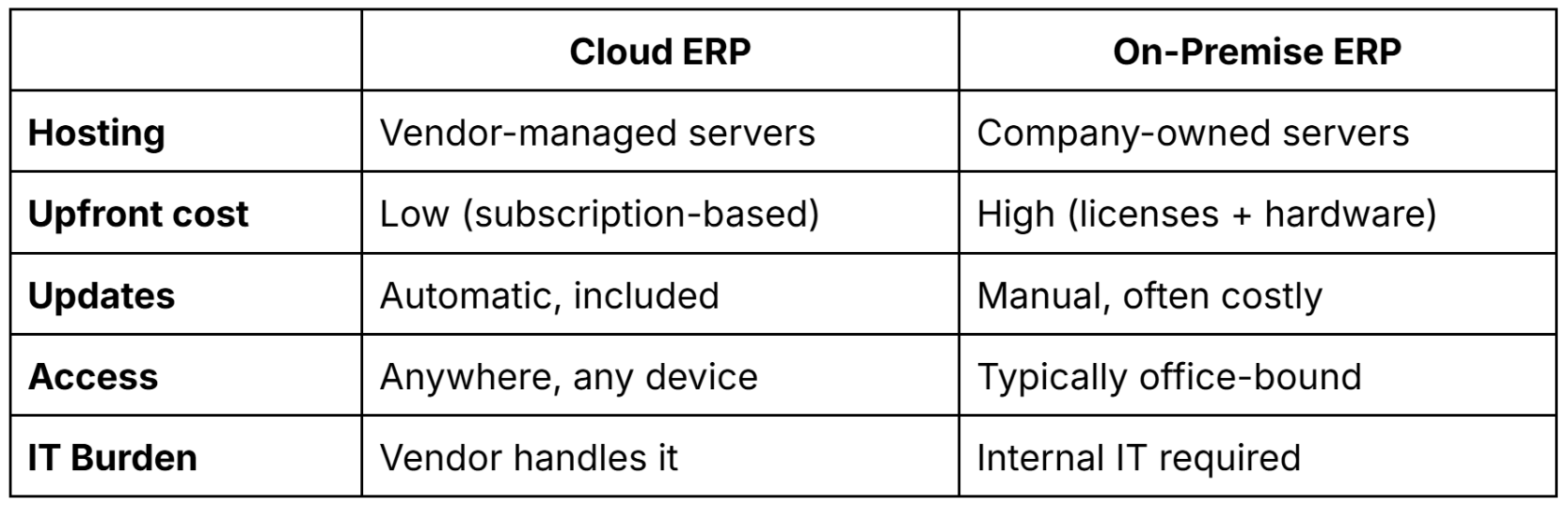
Satisfaction with on-premise ERP systems has dropped sharply from 70% in 2021 to just 38% in 2024, reflecting how legacy infrastructure has struggled to keep pace with operations.
Tools like QuickBooks or Xero are accounting software; they handle the general ledger, payables, receivables, and basic reporting well at a certain scale, but ERP finance platforms go much further.
A true cloud ERP system integrates financial data with operational data across the business: inventory levels, purchase orders, customer contracts, headcount costs, and project margins. When a sales order is placed, it flows automatically into revenue recognition. When a purchase order is approved, it hits the budget in real time. That level of connectivity is what separates ERP finance platforms from standalone accounting tools.
The global cloud ERP system market is projected to nearly double from USD 87.73 billion in 2024 to USD 172.74 billion by 2029, growing at a 14.5% CAGR, showing that companies are replacing fragmented systems with unified platforms.
Not all cloud ERP systems are created equal. Here is what finance leaders at different levels need most.
The CFO technology ecosystem has expanded well beyond ERP and spreadsheets. Today's CFO needs a platform that sits at the center of a connected technology stack and feeds clean, timely data to FP&A tools, board reporting platforms, and risk dashboards.
According to Gartner, over 70% of CFOs now shoulder responsibilities beyond finance, spanning enterprise data strategy, risk, M&A, and procurement. A cloud ERP system that cannot support this expanded load is not a suitable asset.
Key capabilities CFOs need from ERP systems include:
Controllers live by the Financial Close. The monthly and quarterly close is one of the most time-intensive processes in any finance function, and a well-implemented cloud ERP system can compress that timeline significantly.
The best cloud ERP systems for controllers deliver:
FP&A teams are increasingly expected to be strategic partners to the business. This shift is only possible when FP&A professionals have access to clean and real-time data, not numbers exported to a spreadsheet days after close.
The best ERP systems for FP&A teams offer:
Modern finance teams should not run on a single platform, and a cloud ERP system is not a replacement for specialized tools. However, it is the connective factor that makes them work together.
Cloud ERP finance platforms provide the general ledger, actuals, and operational context. FP&A tools layer on budgeting, forecasting, scenario planning, and variance analysis.
The best ERP systems offer native APIs and pre-built connectors that automate data syncs, eliminating manual exports and version-control errors. This is the foundation of a high-functioning CFO technology ecosystem.
For SaaS, subscription, and professional services businesses, the best ERP systems include native subscription billing and revenue recognition modules, or integrate tightly with specialized billing platforms. This ensures revenue flows directly from contracts to the general ledger in support of ASC 606 compliance.
When a deal closes in the CRM, a well-integrated cloud ERP system can automatically generate a customer record, trigger an invoice, and begin tracking the revenue recognition schedule. This gives FP&A teams real-time pipeline-to-revenue visibility.
The financial close process touches every other part of the finance stack. The best cloud ERP systems can centralize close task management, automate recurring entries, support reconciliation workflows, and provide live dashboards, so controllers and CFOs can track progress without chasing emails.
70.4% of ERP deployments are now cloud-based, and 78.6% of new implementations select cloud solutions. For finance leaders evaluating their stack, this trend signals a clear direction: the modern CFO technology ecosystem is built in the cloud.
The right cloud ERP system depends heavily on where your organization sits in its growth journey.
For companies in the $10M to $150M revenue range, the need for a cloud ERP system usually stems from the fact that existing tools have stopped scaling. QuickBooks is hitting its limits, spreadsheet consolidation is taking a week, and the CFO cannot get a reliable cash flow view without a manual effort.
Small and medium enterprises are the fastest-growing segment for cloud ERP. The best ERP systems deliver for growing teams:
For large enterprises with complex organizational structures, a cloud ERP system answers the question: "How do we reduce technical debt and scale what we have?"
The best ERP systems deliver for enterprise teams:
The cloud ERP systems market is large and varied. What should be consistent across every successful cloud ERP system implementation are: the platform should eliminate data separation, accelerate the financial close, empower FP&A teams with real-time data, and serve as the center of a connected CFO technology ecosystem that grows with the business.
For finance leaders evaluating their options, the question is not whether to move to a cloud ERP system. With nearly 80% of new implementations already choosing cloud ERP, and satisfaction with on-premise solutions at historic lows, that decision is clear. The real question is which platform will give your team the foundation to operate at the level your business demands.